Coffea Excelsa: Complete Species Profile
Meet Excelsa (Coffea dewevrei)—the rare, tart-fruited coffee species prized for its unique blending potential and mysterious dark fruit complexity.
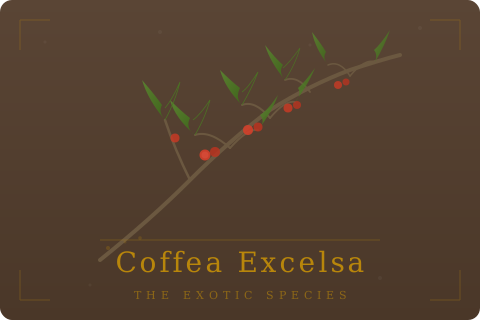
Coffea excelsa (Coffea dewevrei)
“Excelsa represents coffee biodiversity at its finest—a species that challenges our flavor expectations and offers unique contributions to blending and genetic diversity.” — World Coffee Research
Quick Facts
- Species: Coffea dewevrei De Wild. & T.Durand (formerly C. liberica var. dewevrei)
- Family: Rubiaceae
- Common Trade Name: Excelsa coffee
- Origin: Central Africa (primarily Congo Basin and Chad region)
- Chromosome Count: Diploid (2n = 2x = 22)
- Global Production: fewer than 1% of world coffee production (~500,000–1,000,000 bags)
- Caffeine Content: 1.0–1.3% (lowest of the commercial species)
Taxonomic Note
For decades, Excelsa was classified as Coffea liberica var. dewevrei — a variety of Liberica coffee. Modern genetic and morphological studies have since determined that it is sufficiently distinct to warrant its own species status as Coffea dewevrei, named for Belgian colonial administrator Alphonse de Wevre and formally described by botanist Émile De Wildeman in 1904. In commercial and trade contexts, however, “Excelsa” remains the name almost universally used, and the species is often still grouped with Liberica in statistics and market reports. This article uses both names to reflect scientific accuracy and commercial reality.
Overview
Coffea excelsa is the rarest and least understood of the four commercially cultivated coffee species, representing fewer than 1% of global coffee production and virtually absent from international commodity markets. Yet within the specialty blending world, particularly in the Philippines and Vietnam, Excelsa holds a disproportionate importance: its distinctive tart, fruity, dark flavor profile adds complexity and depth to blends in ways that neither Arabica nor Robusta can replicate.
Native to the Central African forests around the Lake Chad basin and the northern edges of the Congo Basin, Excelsa is a medium-to-large tree (5–8 meters in cultivation, up to 12–15 meters in the wild) with characteristics that fall between Liberica and Arabica — smaller than Liberica in most physical dimensions, but larger and more robust than Arabica. Its most distinctive physical feature is its bean shape: asymmetrical, elongated, and pointed like an almond, immediately distinguishable from the more regular oval of Arabica or rounded form of Robusta.
What makes Excelsa genuinely fascinating from a sensory standpoint is a flavor profile unlike anything else in coffee: tart dark fruits, wine-like acidity, woody complexity, and a mysterious back-palate resonance that experienced blenders describe as adding “depth” or “dimension” to compositions. Whether encountered as a single-origin or as a blending component, Excelsa makes an impression. The experience is not universally loved — its flavor is polarizing in the way that strong, unusual wines divide opinion — but it is always memorable.
Botanical Characteristics
Plant Morphology
In cultivation, Excelsa grows to 5–8 meters with a spreading, vigorous habit supported by a strong main trunk and extensive lateral branching. It is intermediate between Liberica (6–9 meters) and Arabica (2–4 meters) in stature, sharing Liberica’s substantial presence while not reaching the forest-tree scale of that species. The lifespan in cultivation is 40–60 years or more under good management.
Leaves are elliptical to lanceolate, 12–20 cm long and 5–9 cm wide — larger than Arabica’s but smaller than Liberica’s enormous leaves — with a leathery texture, dark green color, slightly wavy margins, and prominent venation. The flowers are white, fragrant, and notably self-fertile (like Arabica), clustered in the leaf axils with 5–6 petals and a delicate appearance compared to Liberica’s larger, bolder flowers.
The cherries are the key botanical identifier: distinctively almond- or football-shaped rather than the rounded oval of Arabica or the more elongated form of Liberica. They measure 10–15 mm long and 7–10 mm wide, passing through the standard color progression from green through yellow and orange to dark red at maturity. Excelsa cherries have a notably long maturation period of 10–12 months after flowering, and ripening is irregular — different cherries reaching peak maturity at different times on the same tree, a characteristic that significantly complicates harvest logistics and quality management.
The seeds themselves are the most immediately recognizable feature of the species: uniquely asymmetrical, elongated, and pointed at one end, 9–14 mm long and 6–8 mm wide, with an often irregular central furrow. These almond-like beans are larger than Arabica beans and smaller than Liberica’s, and any experienced green coffee buyer can identify them on sight.
The root system follows the deep taproot pattern of Liberica rather than the shallow lateral system of Robusta, giving Excelsa reasonable drought tolerance once established and good anchorage in varied soil conditions.
Growing Requirements
Excelsa prefers mid-altitude conditions — optimally 200–800 meters — that distinguish it from both Robusta (lowland optimum) and Arabica (highland optimum). This intermediate altitude preference, combined with tolerance for temperatures of 20–28°C, positions Excelsa for growing zones that are too warm for quality Arabica production but sit above the lowland heat that Robusta’s native habitat represents.
Annual rainfall requirements of 1,500–2,500 mm are similar to Arabica, but Excelsa tolerates moderate dry seasons and shows better drought resilience once established, reflecting its Central African forest heritage where seasonal variation is significant. It adapts to a range of soil types from sandy loam to clay loam, manages in soils of lower fertility than Arabica requires, and tolerates full sun or partial shade — the latter being its natural condition as a mid-story forest tree.
Genetic Background
Excelsa/C. dewevrei is a diploid (2n = 22), sharing its chromosome number with Robusta, Liberica, and most other members of the Coffea genus. The genetic separation from Liberica that justifies its species-level distinction was confirmed through studies of molecular markers and morphological characteristics showing consistent differences between the two species’ gene pools.
Wild Excelsa populations are found in the Chad Basin, the northern Congo region, and the Central African Republic — areas of significant political instability and limited scientific access that have made genetic characterization difficult. The species is poorly represented in international gene banks, and its genetic diversity in wild populations is documented only incompletely. No formal breeding program has ever targeted Excelsa for improvement; the plant in cultivation is essentially the same as it was when first introduced to Southeast Asia in the early 20th century, maintained through farmer-saved seed and informal selection rather than scientific development.
Cross-compatibility with other diploid coffees — Liberica and Robusta — is theoretically possible, and the species could potentially serve as a genetic bridge in breeding programs, but this potential has not been explored commercially.
Disease and Pest Resistance
Excelsa’s disease resistance profile is moderate — better than Arabica, less impressive than Robusta. Coffee Leaf Rust (Hemileia vastatrix) finds Excelsa more resistant than Arabica but not immune, and resistance varies between individual plants and populations. Coffee Berry Disease and most root pathogens show similar patterns: moderate resistance compared to Arabica’s vulnerability. The limited commercial scale of Excelsa cultivation means that pest and disease interactions are poorly studied, and extrapolating from the more intensively researched Liberica is the best available approximation.
Like all coffee species, Excelsa has no effective resistance to the Coffee Berry Borer (Hypothenemus hampei), which remains a universal challenge across the genus.
The species’ moderate disease resistance, combined with its tolerance of a wide altitude range and variable soils, gives it potential value as an alternative crop in areas where Arabica disease pressure is high and Robusta’s flavor is considered too limited for local or specialty markets.
Flavor Profile
The Excelsa Experience
Excelsa’s flavor is best understood as occupying a unique sensory space that neither Arabica nor Robusta can reach. Where Arabica’s acidity ranges from bright citrus to malic apple, Excelsa’s acidity is tart and wine-like — closer to the fermented complexity of a natural Arabica than to the clean brightness of a washed one. The body is medium to full, smooth and syrupy, with good viscosity. Sweetness is present but restrained — dark fruit sweetness rather than Arabica’s honey and caramel.
The most distinctive characteristic is what happens on the back palate: Excelsa has a resonance and persistence in the aftertaste, a lingering complexity that experienced tasters describe as “mysterious” or “dimensional.” Dark fruits — plum, black cherry, grape — combine with woody sandalwood notes and subtle floral undertones to create something that evolves interestingly as the cup cools.
Flavor descriptors that appear consistently in well-processed Excelsa include: tart dark fruit, wine-like acidity, jackfruit and passion fruit (particularly in Southeast Asian growing contexts), cedar and sandalwood, dark chocolate, and occasionally a bubblegum or tropical candy note that has become something of a signature for the species.
Sensitivity to Processing
Excelsa’s flavor is highly sensitive to processing quality — perhaps more so than any other coffee species. Poor processing amplifies the species’ harder edges: excessive woody notes, unpleasant harshness, and an earthy pungency that can dominate the cup. Good processing, particularly wet (washed) methods applied to selectively harvested ripe cherries, can produce a surprisingly refined and complex beverage. Natural processing enhances the dark, winey fruit characteristics, creating a more maximalist version of Excelsa’s profile. The irregular cherry ripening that complicates Excelsa cultivation also complicates consistent processing: lots with mixed ripeness produce mixed quality.
Blending Value
Excelsa’s primary commercial application has always been blending rather than single-origin production. Small additions of 5–20% Excelsa to Arabica or Robusta blends introduce complexity and depth that neither species provides alone. Vietnamese premium Robusta blends use Excelsa to elevate what would otherwise be straightforward commodity coffee. Philippine traditional blends — the regional “Barako” compositions that mix Liberica, Excelsa, and Arabica — rely on Excelsa for the mysterious back-palate quality that makes those blends distinctive.
For specialty roasters seeking differentiation, a small Excelsa component offers a genuine flavor contribution that cannot be replicated by processing innovation alone. The species essentially adds a fourth dimension to the Arabica-Robusta palette.
Geographic Distribution
Excelsa’s global footprint is the smallest of all four commercial species. The Philippines is the world’s largest producer at an estimated 300,000–500,000 bags annually, where it is grown alongside Liberica and Arabica in Luzon and blended into traditional coffee preparations. Vietnam is the second-largest producer at roughly 100,000–200,000 bags, where it has been adopted by a growing number of Central Highlands producers as a blending component for premium coffees. Malaysia, Laos, and Cambodia have minor production, and the species’ origin region in Central Africa — Chad, the Central African Republic, and the northern Congo — has very limited commercial cultivation, though this is where wild populations with the broadest genetic diversity occur.
Unlike Arabica and Robusta, Excelsa is not traded on commodity exchanges, not tracked independently by the International Coffee Organization, and not present in most international green coffee markets. Almost all production is consumed in origin countries or traded through informal regional networks.
Conservation and Future Potential
The conservation status of wild Excelsa populations is uncertain. The species has not been formally assessed by the IUCN, and its distribution in politically challenging regions of Central Africa has limited systematic study. Deforestation in the Congo Basin and Central African Republic — some of the world’s most ecologically important forests — threatens wild Excelsa alongside thousands of other species. The limited representation of wild Excelsa germplasm in international gene banks means that genetic erosion could occur with little warning.
The case for greater attention to Excelsa overlaps with the argument for Liberica: as climate change reduces the viable growing area for Arabica and pushes producers toward lower-altitude alternatives, the moderate heat tolerance and disease resistance of diploid African species like Excelsa and Liberica become increasingly relevant. Excelsa’s ability to grow at 200–800 meters — below Arabica’s optimal zone but above Robusta’s — positions it for regions experiencing precisely the conditions that are expected to proliferate: too warm for quality Arabica, not quite the lowland environment where Robusta dominates.
For specialty coffee, the future may hold more Excelsa than the present does. Growing consumer interest in unusual and heritage coffees, the premium that experimental blending commands, and the compelling story of a near-unknown species with genuinely unusual flavors all point toward opportunity. Whether that opportunity is realized depends on investment in processing infrastructure, market development, and the research attention that has, to date, gone almost entirely to Arabica and Robusta.
Comparison with Other Species
| Characteristic | Excelsa | Arabica | Robusta | Liberica |
|---|---|---|---|---|
| Tree Height | 5–8m | 2–4m | 4–6m | 6–9m |
| Altitude | 200–800m | 600–2,100m | 0–800m | 0–600m |
| Bean Shape | Almond-like, asymmetrical | Oval, regular | Round, small | Large, irregular |
| Flavor | Tart, fruity, dark, wine-like | Sweet, acidic, complex | Bitter, earthy | Woody, fruity, polarizing |
| Global Production | fewer than 1% | 60–62% | 38–40% | fewer than 2% |
| Caffeine | 1.0–1.3% | 1.2–1.5% | 2.2–2.7% | 1.2–1.5% |
| Primary Use | Blending | All uses | Instant, espresso blends | Local/regional consumption |
References
- Davis, A. P., et al. “Growing coffee (Coffea and Psilanthus; Rubiaceae): Psilanthus recharacterised and the new commercial species C. charrieriana described.” Botanical Journal of the Linnean Society, vol. 167, 2011.
- Davis, A. P., et al. “An annotated taxonomic conspectus of the genus Coffea (Rubiaceae).” Botanical Journal of the Linnean Society, vol. 152, 2006.
- De Wildeman, Émile. Notices sur des plantes utiles ou intéressantes de la flore du Congo. Brussels, 1904.
- Gomez, C., et al. “Current status and future prospects of Coffea canephora and related wild relatives.” Genetic Resources and Crop Evolution, 2009.
- Specialty Coffee Association. “Sensory Analysis of Rare Coffee Species: Excelsa.” SCA Technical Series, 2022.
- Philippine Coffee Board. Excelsa Coffee: Cultivation and Processing in the Philippines. 2023.
- Vietnam Coffee and Cocoa Association. Coffee Varieties and Blending Practices in Vietnam. VICOFA, 2023.
- World Coffee Research. Sensory Lexicon for Coffee. 3rd ed., worldcoffeeresearch.org, 2023.
- Wintgens, Jean Nicolas, ed. Coffee: Growing, Processing, Sustainable Production. 2nd ed., Wiley-VCH, 2009.
- Charrier, A., and Berthaud, J. “Botanical classification of coffee.” In Coffee: Botany, Biochemistry and Production, Springer, 1985.
Continue Reading
More articles you might enjoy
Bourbon: Coffee Variety Profile
The complete guide to Bourbon coffee—the naturally sweet Arabica mutation from Reunion Island that parented Caturra, Catuai, and modern specialty.
Coffea Arabica: Complete Species Profile
Explore the world's most important coffee species—from Ethiopian origins and genetic background to flavor profiles, growing conditions, and sustainability challenges.
Coffea Liberica: Complete Species Profile
Discover Liberica coffee—the rare, large-fruited species with a polarizing flavor profile, deep cultural roots in the Philippines and Malaysia.