Typica: The Original Coffee Variety Profile
The definitive guide to Typica—the foundational Arabica variety behind Jamaica Blue Mountain, Kona, and the genetic ancestor of modern coffee.
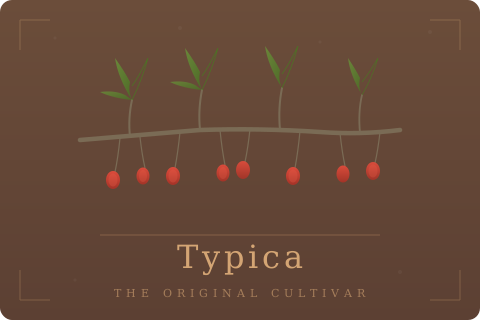
Typica
“Typica is the Adam of coffee varieties—nearly every cultivated Arabica traces its lineage back to this foundational variety.” — World Coffee Research
Quick Facts
- Species: Coffea arabica
- Lineage: Original Arabica variety (no known cultivated parents)
- Origin: Southwestern Ethiopia → Yemen → Java
- Tree Type: Tall, conical shape; 3.5–4 meters in cultivation
- Yield: Low (300–600 kg green/hectare under typical conditions)
- Quality Potential: Excellent (clean, sweet, balanced)
- Disease Resistance: Low (highly susceptible to rust and berry disease)
- Common Names: Typica, Criollo (Latin America), Sumatra, Arabigo, Pluma Hidalgo
Overview
Typica is the original cultivated coffee variety, representing the genetic foundation from which most of the Arabica coffee grown worldwide descends. Its journey from the highland forests of southwestern Ethiopia through Yemeni cultivation to global spread is one of the most consequential chapters in agricultural history: a single genetic lineage, moved by trade routes, colonial ambitions, and the insatiable human desire for coffee, spreading across continents over three centuries to become the backbone of an industry now supporting over 125 million livelihoods.
The name “Typica” comes from the Latin word meaning “typical” or “representative” — and it is representative in the most literal sense. This variety established the standard characteristics against which all other Arabica varieties are measured: tall, elegant plants with slightly bronze-tipped young leaves, a graceful conical silhouette, excellent cup quality with clean sweetness and balanced acidity, and the practical challenges of low productivity and high disease susceptibility that have led to its gradual replacement by more resilient modern varieties.
Despite being largely superseded in commercial production, Typica remains treasured where it persists. Jamaica Blue Mountain — perhaps the world’s most famous single-origin coffee, commanding prices of $50–100 or more per pound — is Typica. Hawaiian Kona, the second most expensive American coffee, is Typica. The genetic reference genome for all Arabica research is Typica. For specialty coffee producers, historians, and plant geneticists alike, Typica is irreplaceable.
Botanical Characteristics
Plant Morphology
Typica is a tall, graceful plant — the coffee world’s equivalent of an heirloom apple tree or an old-growth vine. In cultivation it reaches 3.5–4 meters, but left unpruned it can grow to 5–6 meters, requiring significant height management to make harvesting practical. Its silhouette is distinctively conical: the plant tapers from a wider base to a pointed apex, with long primary branches extending at 50–70 degree angles and creating an open, airy architecture that allows light to penetrate throughout the canopy.
The leaves are elliptic to elongated, 12–15 cm long with a slightly glossy surface and prominent midrib. The most reliable diagnostic feature of Typica is the color of new growth: young leaves emerge with a distinct reddish or bronze tint, a characteristic botanists and farmers use to distinguish Typica from Bourbon (which has green young leaves). This bronze-tip feature has been noted in descriptions of Typica since the earliest botanical accounts of cultivated Arabica.
Branch internodes — the segments between branch nodes — are long, typically 5–8 cm. This contributes to the open, spacious architecture and also explains one of Typica’s agronomic weaknesses: long internodes mean fewer fruiting nodes per length of branch, reducing yield potential compared to more compact varieties like Bourbon or Caturra where shorter internodes pack more cherry-bearing nodes into the same branch length.
Typica flowers are white and fragrant, self-pollinating in the characteristic Arabica fashion. The cherries are elongated and oval, ripening to deep red over 6–9 months. Ripening is uneven — different cherries on the same tree reach peak maturity at different times — requiring multiple selective picking passes across a harvest season of 2–4 months. This labor intensity is part of the cost structure that has made Typica economically challenging in competitive markets.
Growing Requirements
Typica is among the more demanding Arabica varieties in its environmental requirements. It performs best at 1,200–1,800 meters altitude with temperatures of 18–22°C and moderate, well-distributed annual rainfall of 1,500–2,000 mm. At lower altitudes or warmer temperatures, both flavor quality and productivity decline. The variety is particularly sensitive to frost — temperatures below 10°C cause damage — and is susceptible to temperature extremes in both directions.
Shade is strongly beneficial for Typica, particularly below 1,400 meters. The variety evolved as an understory plant and retains the shade preference of its forest origins: partial shade (30–50%) reduces temperature stress, moderates humidity, decreases disease pressure, and improves cup quality by slowing cherry development. At high altitudes above 1,600 meters, full sun cultivation is viable, though many producers maintain some shade for quality reasons even there.
Soil requirements are strict: deep, well-draining soils with good organic matter and pH of 6.0–6.5 are essential. Volcanic soils are ideal, which is why Typica reaches its greatest commercial expression in Jamaica’s Blue Mountains, Hawaii’s volcanic slopes, and Ethiopia’s highland terroir — all geologically appropriate environments. Typica’s tolerance for poor soils is low; it simply does not perform well on thin, compacted, or waterlogged ground.
Disease and Pest Susceptibility
Typica’s disease vulnerability is its most significant practical limitation and the primary reason it has been displaced from most commercial production globally. Coffee Leaf Rust (Hemileia vastatrix) is by far the most consequential threat. When rust arrived in Ceylon (now Sri Lanka) in the 1860s and spread through the island’s Typica plantations over the following two decades, it completely destroyed what had been one of the world’s most productive coffee-growing regions by the 1890s. Ceylon’s transition from coffee to tea — a shift still reflected in the country’s modern identity as a major tea exporter — was caused directly by Typica’s inability to resist rust.
Similar rust epidemics have recurred throughout coffee history wherever Typica and its close relatives are grown without intensive fungicide management or shade protection. In Central America’s 2012–2013 epidemic, Typica-based varieties suffered the most severe yield losses. East African producers growing Typica face recurrent Coffee Berry Disease (Colletotrichum kahawae) pressure, particularly in the wet highland conditions that also produce the finest cup quality. Root-parasitic nematodes cause significant losses where soils are poorly managed or where Typica is planted on low-organic soils without nematode-resistant rootstock.
The fundamental vulnerability is genetic: Typica’s narrow gene pool, descended from a small founding population, lacks the diversity to express meaningful resistance to pathogens it didn’t encounter during its evolutionary history in Ethiopian forests. Managing Typica commercially requires active disease management — shade programs, sanitation, fungicides — that adds cost to an already low-yielding variety.
Yield Characteristics
Typica is the lowest-yielding major Arabica variety under standard cultivation conditions. Well-managed Typica produces 300–600 kg of green coffee per hectare annually, compared to 600–1,000 kg for Bourbon, 1,200–2,000 kg for Caturra, and 1,500–2,500 kg for the modern Catuai variety. Intensive management with very high planting densities can push Typica yields to 800–1,200 kg per hectare, but this requires exceptional inputs that are rarely economically justified at commodity prices.
Three structural factors limit Typica’s yield. First, long branch internodes reduce the number of fruiting nodes per plant. Second, the tall plant architecture requires extensive pruning management and makes harvesting expensive in labor time per unit of fruit. Third, Typica has a pronounced biennial bearing tendency — high-yield “on years” followed by low-yield “off years” — which makes farm income planning difficult.
The economics work only when quality premiums justify the yield disadvantage. Jamaica Blue Mountain succeeds commercially because protected geographic indication status and long-established reputation allow prices of $50–100 per pound green — multiples of what other specialty coffees command. Hawaiian Kona similarly supports Typica cultivation through premium positioning and the US domestic market’s willingness to pay for local provenance. For producers without equivalent market access, Typica’s quality advantage over higher-yielding varieties rarely compensates for its output deficit.
Flavor Profile
Cup Character
Typica is celebrated for what specialty coffee professionals call “cup clarity” — a transparent, clean expression of origin character unobscured by processing off-flavors, defects, or varietal peculiarities. When grown at appropriate altitude with careful harvesting and processing, Typica produces coffee with pronounced natural sweetness (from high sucrose content that caramelizes beautifully during roasting), bright but balanced acidity, silky medium body, and layered complexity that evolves as the cup cools.
The flavor vocabulary for Typica’s highest expressions includes floral notes of jasmine and orange blossom, fruit notes ranging from red apple to stone fruit, milk chocolate and cocoa, caramel and brown sugar sweetness, and subtle almond or hazelnut nuttiness in the finish. The acidity is bright and lively — primarily citric and malic acids — but never harsh, balanced by the sweetness that is Typica’s signature attribute. The body is medium, smooth, and refined rather than heavy, giving the cup an elegant rather than powerful impression.
Cupping scores for well-grown Typica typically land in the 84–88 range on the SCA 100-point scale, with exceptional lots from Jamaica Blue Mountain or high-altitude Ethiopian Typica farms reaching 88–92 points. These scores compare favorably with all but the finest single-lot Bourbons and Ethiopian heirlooms.
Terroir Sensitivity
One of Typica’s most important qualities from a specialty coffee perspective is its transparency to terroir. Because the variety does not add strong varietal characteristics of its own — it isn’t a flavor-forward variety the way some modern cultivars are — it becomes a kind of lens for the growing environment. Typica grown in Jamaica’s Blue Mountains tastes unmistakably Jamaican: a particular clarity, brightness, and balance shaped by the high rainfall, cool temperatures, and volcanic soil of that specific geography. Kona Typica from Hawaii’s volcanic slopes carries a different but equally specific character. Typica from Indonesia’s Sumatra, processed by the wet-hulling Giling Basah method, produces a strikingly different cup — earthy, herbal, full-bodied — that reflects both the genetic variety and the radical processing technique.
This terroir transparency is why Typica has been so important historically: the variety spread to diverse growing environments worldwide and produced recognizably different cups in each one, giving each origin a distinct sensory identity rooted in place.
Geographic Distribution and Notable Origins
Jamaica Blue Mountain
Jamaica Blue Mountain Typica, grown in the Blue Mountain range of eastern Jamaica at 900–1,500 meters, is the world’s most iconic Typica expression. Coffee was first planted in Jamaica in 1728 by Governor Sir Nicholas Lawes, who brought plants from Martinique — themselves descended from the famous single seedling sent to France from Java in 1706. The Blue Mountain’s unique combination of deep volcanic soils, abundant rainfall (up to 2,000 mm annually), persistent mist, and cool temperatures at high altitude produces a cup famous for its exceptional balance, bright but restrained acidity, mild sweetness, and absence of bitterness.
Protected by a geographic indication and regulated by the Coffee Industry Board of Jamaica, Blue Mountain coffee commands prices of $50–100 per pound or more, with Japan buying approximately 80% of the annual production. Whether the premium reflects genuine quality or marketing mythology is debated among specialty coffee professionals, but at its best, Blue Mountain Typica is undeniably exceptional.
Hawaii Kona
Hawaiian Kona Typica, grown on the western slopes of the Hualalai and Mauna Loa volcanoes on the Big Island, represents the only significant American domestic coffee production. Coffee arrived in Hawaii from Brazil in 1825, and the Kona district’s combination of volcanic soil, afternoon cloud cover that moderates heat and moisture, and elevation of 150–900 meters has sustained a distinctive Typica-based production for two centuries. The geographic indication designation protects the “Kona” name, though regulatory enforcement of the 10% blending rules that allow other coffees to be sold as “Kona blend” has been a persistent controversy.
Sumatra (Indonesia)
The earliest Asian Typica cultivation outside Yemen began in Java in 1696 when Dutch colonial administrators obtained plants from Yemen. From Java, cultivation spread to Sumatra, where a distinct processing tradition developed: Giling Basah (wet-hulling), in which partially dried parchment coffee is hulled while still at elevated moisture content, creating the distinctive earthy, herbal, full-bodied character associated with Sumatran coffees from Mandheling, Linton, and Aceh Gayo. The Sumatran flavor profile is one of the most polarizing in specialty coffee — enthusiasts value its complexity and weight; critics find it “dirty” or “musty” — but it demonstrates Typica’s capacity for radical flavor transformation through processing innovation.
Latin American Heritage
Typica (often called “Criollo” or “Arabigo” locally) persists in heritage form on smaller farms in Mexico (particularly Pluma Hidalgo in Oaxaca), Peru (Amazonas, San Martin), Colombia (older farms in Huila and Nariño), and scattered estates throughout Central America. These farms often combine Typica cultivation with organic practices and shade systems, and their coffees command specialty premiums when quality is well-managed.
Genetic Importance
The genetic significance of Typica extends far beyond its own direct cultivation. It is the source variety from which Bourbon diverged through spontaneous mutation on Reunion Island around 1715–1720. Bourbon in turn gave rise to Caturra, Pacas, Villa Sarchi, and numerous other compact mutations. The Typica × Bourbon cross produced Mundo Novo in Brazil, which combined with Caturra to create Catuai — now one of the most widely grown Arabica varieties globally. Ethiopian heirloom varieties trace shared genetics with Typica through the species’ common ancestry. The Arabica reference genome sequenced by scientists in 2014 — the molecular map used for all genetic research on the species — is based on Typica.
Literally hundreds of named Arabica varieties trace meaningful genetic heritage to Typica. Understanding it is, in a real sense, understanding the genetic architecture of global coffee.
Historical Timeline
The spread of Typica from Yemen to the world is one of agriculture’s most dramatic stories of diffusion. In 1616, Dutch traders obtained coffee plants from Yemen — breaking the Yemeni monopoly on coffee cultivation that had held for more than a century. By 1696, Dutch colonial administrators had established successful Typica cultivation in Java. A seedling from Java was sent to Amsterdam’s botanical garden in 1706. Louis XIV of France received one of these seedlings as a gift from Amsterdam in 1714. In 1720, a French naval officer named Gabriel de Clieu carried a single seedling from Louis XIV’s greenhouse to the Caribbean island of Martinique — and from that one tree, through cuttings and seedlings distributed across the French and Spanish colonial Caribbean, most of the Western Hemisphere’s Arabica production ultimately descends.
Brazil, now the world’s largest coffee producer, received its first Typica plants in 1727 from the governor of French Guiana, brought to the Amazon region by Portuguese officer Francisco de Melo Palheta under circumstances that may have involved romantic subterfuge. Jamaica received Typica in 1728. Hawaii in 1825. By the mid-19th century, Typica’s descendants were growing on every continent with suitable tropical or subtropical conditions.
Economic Considerations
Typica is economically viable only at premium prices. The combination of low yield, high labor requirements, strict growing conditions, and significant disease management costs means that commodity pricing — currently around $4–6 per pound for Arabica on the New York C market — does not support profitable Typica cultivation in most contexts. The economic models that work for Typica are premium specialty markets (Blue Mountain, Kona, and comparable heritage origins), direct trade relationships with specialty roasters willing to pay $8–20 per pound for well-grown Typica, or tourism and cultural economy contexts where Typica serves as a heritage attraction rather than a primary agricultural commodity.
This economic reality has driven the widespread replacement of Typica with Bourbon, then Caturra, then Catuai across most commercial production since the 1950s. The trend has been uniform across producing regions: each wave of more productive varieties captures market share from Typica’s lower-yielding beauty. The persistence of Typica in Jamaica, Hawaii, and select specialty-oriented farms worldwide represents a deliberate choice to prioritize quality and heritage over volume — a niche that the specialty market can support in limited quantities.
Summary
Typica is more than a coffee variety — it is coffee history incarnate. From its origins in Ethiopian highland forests through Yemeni cultivation and centuries of global spread, Typica’s journey mirrors humanity’s relationship with coffee itself. While modern agriculture has largely moved on to higher-yielding, disease-resistant varieties, Typica persists where conditions and markets make exceptional quality the priority over maximum production.
For coffee professionals and enthusiasts, Typica represents the standard of excellence: what Arabica quality means at its finest. For geneticists, it is the reference baseline for the entire species. For historians, it is a living artifact of the trade routes, colonial movements, and cultural exchanges that shaped the modern world. And for the farmers of Jamaica, Hawaii, Indonesia, and the scattered heritage estates that maintain it, Typica is a commitment to a quality of coffee that has not been improved upon in three centuries — only traded away for productivity.
References
- Ukers, William H. All About Coffee. Tea and Coffee Trade Journal Co., 1922.
- Denoeud, F., et al. “The coffee genome provides insight into the convergent evolution of caffeine biosynthesis.” Science, vol. 345, 2014.
- Anthony, F., et al. “The origin of cultivated Coffea arabica L. varieties revealed by AFLP and SSR markers.” Theoretical and Applied Genetics, vol. 104, 2002.
- World Coffee Research. Arabica Variety Catalog. 4th ed., worldcoffeeresearch.org, 2024.
- Haarer, A. E. Modern Coffee Production. Leonard Hill, 1956.
- Wintgens, Jean Nicolas, ed. Coffee: Growing, Processing, Sustainable Production. 2nd ed., Wiley-VCH, 2009.
- Jamaica Coffee Industry Board. Blue Mountain Coffee Production Standards and History. 2023.
- Hawaii Department of Agriculture. Kona Coffee: History, Standards, and Geographic Indication. 2022.
- Specialty Coffee Association. Arabica Variety Technical Handbook. sca.coffee, 2023.
- Van der Vossen, H. A. M. “The cup quality of disease-resistant cultivars of Arabica coffee (Coffea arabica).” Experimental Agriculture, vol. 45, 2009.
Continue Reading
More articles you might enjoy
Bourbon: Coffee Variety Profile
The complete guide to Bourbon coffee—the naturally sweet Arabica mutation from Reunion Island that parented Caturra, Catuai, and modern specialty.

Coffea Excelsa: Complete Species Profile
Meet Excelsa (Coffea dewevrei)—the rare, tart-fruited coffee species prized for its unique blending potential and mysterious dark fruit complexity.
Coffea Arabica: Complete Species Profile
Explore the world's most important coffee species—from Ethiopian origins and genetic background to flavor profiles, growing conditions, and sustainability challenges.